MIT Names Two Sigma Co-Founder David Siegel Its Next Innovation Fellow for AI and Science
MIT says David Siegel will spend 2026-27 with the Schwarzman College of Computing exploring how AI can speed scientific discovery. The announcement is long on pedigree and short on deliverables.
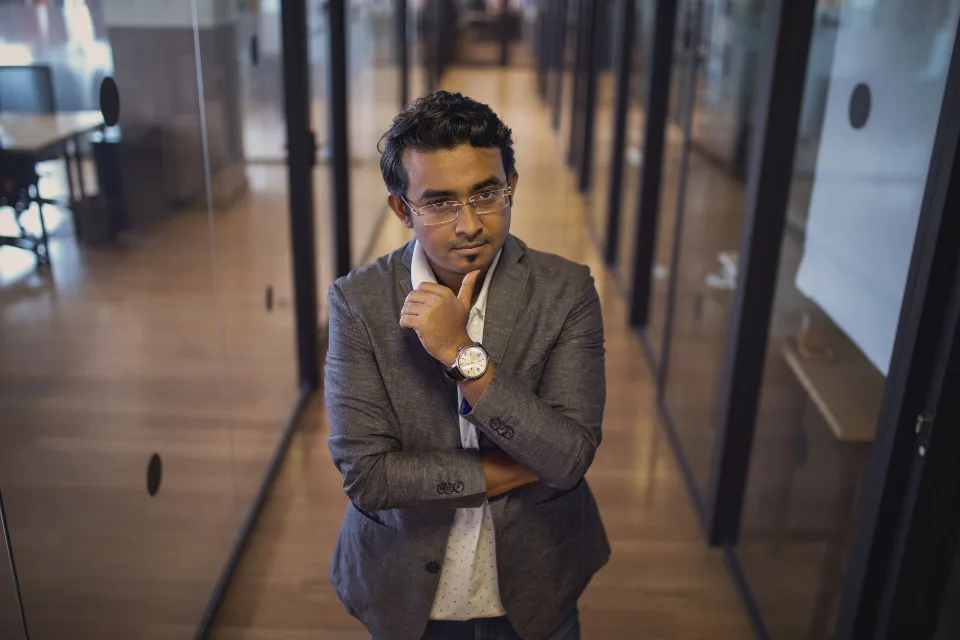
MIT announced that David Siegel SM '86, PhD '91 — a computer scientist, Two Sigma co-founder and philanthropist — will serve as its next Innovation Fellow during the 2026-27 academic year, working with the MIT Schwarzman College of Computing on how artificial intelligence can accelerate scientific discovery. The appointment ties together several threads already running through the Institute, including the recently renamed MIT Siegel Family Quest for Intelligence and Open Athena, the nonprofit Siegel founded in 2024 that MIT says works with the university. What the fellowship will actually produce — programs, funding, joint research, or simply advice — is not spelled out in the announcement.
What the role is, and what it isn't
MIT describes Innovation Fellows as people who spend a year or more in residence, drawing on their experience and networks to engage with faculty and students, appear at public events, and give strategic counsel to Institute leaders. That is an advisory and convening role, not a faculty appointment or a research directorship. Previous fellows named by MIT include former White House National Economic Council director Brian Deese, former IBM chair and CEO Virginia Rometty, former Alphabet executive chair Eric Schmidt, the late former U.S. Secretary of Defense Ash Carter, and former Massachusetts Governor Deval Patrick.
MIT says Siegel will help guide the Institute's focus on using AI to support scientific discovery, working closely with the Schwarzman College of Computing and departments across the college, with an eye toward extending their impact beyond MIT. No specific initiatives, budgets, hiring plans, or compute commitments were disclosed. Whether the fellowship carries compensation, and how potential conflicts will be managed given Siegel's overlapping roles as an investor, donor and MIT Corporation life member, is also not addressed in the announcement.
For readers who track how AI research gets funded and organized, that ambiguity is the most interesting part. Advisory residencies of this kind can produce durable programs or can amount to a year of high-profile talks. The track record of the program's previous fellows is not detailed in MIT's announcement, so there is no public basis in this source for predicting which it will be.
A long institutional history
Siegel's connection to MIT is unusually deep for an outside fellow. According to MIT, he earned a master's degree in 1986 and a PhD in 1991 after a bachelor's in electrical engineering and computer science from Princeton in 1983, and worked at the MIT Artificial Intelligence Lab — now CSAIL — in Professor Tomás Lozano-Pérez's group on human-machine interaction, contributing to what MIT characterizes as a pioneering humanlike robotic hand.
Since then he has been a life member of the MIT Corporation, served on its Executive Committee, and co-chairs the External Advisory Committee for the Schwarzman College of Computing. MIT also says he was an early champion of the Quest for Intelligence, the Institute-wide effort studying intelligence in brains and machines, which was recently renamed the MIT Siegel Family Quest for Intelligence. The terms of that naming were not disclosed in the announcement.
MIT President Sally Kornbluth called Siegel a thought partner to her and other Institute leaders and cited his technical insight and entrepreneurial experience. Provost Anantha Chandrakasan pointed to his doctoral work in the AI Lab and his involvement with the Quest and the college. Dan Huttenlocher, dean of the Schwarzman College of Computing, said he has known Siegel since they were both graduate students and expects him to help identify concrete paths for research, education and engagement. Siegel, for his part, said using AI to accelerate scientific discovery is "the ultimate engineering challenge" and described MIT as the best launchpad for that work.
Open Athena and Marin are the substantive hook
The most concrete piece of the announcement is not the fellowship itself but the organization behind it. MIT says Siegel founded Open Athena in 2024 in response to the resource gap between academic research labs and frontier AI, and that the nonprofit supplies academic labs with AI talent, data engineering expertise and computational resources. Open Athena is described as working with leading global institutions including MIT and as funded by philanthropic partners including Bloomberg Philanthropies, Google, The Huang Foundation, and Schmidt Sciences.
Open Athena is also developing Marin, which MIT describes as a 535-billion-parameter foundation model built entirely in public, with every dataset and experiment shared in real time so that the science of frontier AI remains a public asset. That is a striking claim, and it is worth noting what the announcement does not provide: no training compute figures, no benchmark results, no license terms, no release timeline, no architecture details, and no explanation of how real-time dataset publication squares with copyright, licensing and privacy constraints that have shaped other open-weight efforts. Parameter count alone says little about capability, and fully open data pipelines at that scale are hard to sustain. Anyone evaluating Marin should wait for the artifacts rather than the description.
The broader premise — that academic labs cannot match industry compute and talent, and that philanthropy should close part of that gap — is a real structural problem. It is also a partial fix. Philanthropic compute is discretionary, concentrated in a small number of funders, and does not change the underlying economics of frontier training runs. Notably, Google appears among Open Athena's funders, which means at least one frontier lab's parent company is helping underwrite an effort framed as an alternative to closed frontier research.
The rest of the portfolio
MIT notes that Siegel founded several early internet ventures before co-founding Two Sigma in 2001, a firm it describes as approaching investing through a data science and engineering lens using AI, machine learning and quantitative modeling. He retired from day-to-day management in 2024 and remains co-chair. His Siegel Family Endowment, established in 2011, backs organizations including the Scratch Foundation, Center on Rural Innovation, Khan Academy, Pursuit and The Aspen Institute. He invests through a family office, Shinrai Management, including in startups founded by MIT students and alumni. In 2025 he was appointed to the U.S. Department of Energy's Office of Science Advisory Committee.
His first book, "When Machines Act: The Promise and Peril of Navigating Our Agentic AI Future," co-authored with Yale's Jeffrey Sonnenfeld and Stephen Henriques, is due from MIT Press in March, timed to the residency. MIT says it draws on interviews with technology leaders and off-the-record discussions with more than 300 CEOs, and offers guidance on where to deploy autonomous AI and how to govern it. The sample size is notable; the methodology behind those conversations was not described.
What to watch
- Whether the fellowship yields named programs, funding commitments or joint research with the Schwarzman College of Computing, or stays at the level of advice and public events. None were announced.
- Marin's first public artifacts: weights, license, training data documentation, evaluation results and reproducibility claims. The 535-billion-parameter figure is the only technical detail MIT provided.
- How Open Athena allocates compute and talent across academic partners, and whether its funders — including Google — have any role in setting research direction. The governance structure was not disclosed.
- Conflict-of-interest handling, given that Siegel is simultaneously an MIT Corporation life member, a donor associated with a renamed Institute initiative, an advisory committee co-chair, and an investor in startups founded by MIT affiliates.
- Whether "AI for scientific discovery" at MIT converges on specific domains with measurable results, or remains a broad framing. The announcement named no target fields.
Keep reading
More in Industry →MIT's Data Science Chief Says Universities Should Prepare for AI That Outthinks Them
MIT's Sasha Rakhlin argues that fast verification is accelerating AI in math and code, and that universities must rethink credit, training and shared research infrastructure now.
6 min read
Oracle Says 130,000 Employees Now Use ChatGPT, 95,000 Use Codex
OpenAI's new Oracle case study reports 130K ChatGPT users, 95K+ Codex users and a 98% cut in recruiting research time. The numbers are striking, and entirely self-reported.
5 min read
Anthropic Commits $150M in Claude Access to the Federal Genesis Mission
Anthropic says it will put $150 million over three years behind the federal Genesis Mission, bringing Claude to more than 15 agencies including NASA, NIH and NSF.
5 min read